
Who Was Bobby Webb? Solving the Identity Behind a Family Photograph
Sometimes a family mystery begins with almost nothing: a photograph, a handwritten name, and a question no one can answer. In this case, a 1950 photograph from the family album of Grace Eleanor Tebbetts Crowley was labeled simply “Bobby & Grace.” The man in the photograph was known to the family as Bobby Webb—but who was he? Why had Grace kept his photograph? And what connection did he have to her life? Reedistry set out to reconstruct his identity from the historical record—following each clue, testing each assumption, and separating what could be proved from what remained unknown.
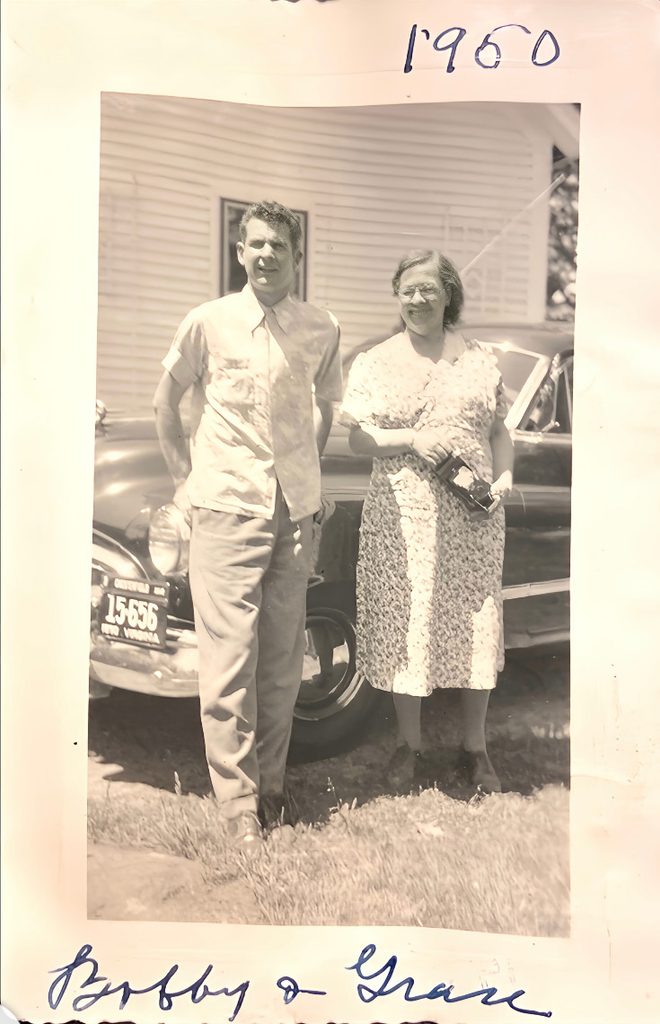
The Photograph That Started the Search
It started with a photograph.
Among the family photographs preserved for decades was an image dated 1950. Written on it, in the handwriting of Grace Eleanor Tebbetts Crowley, was a name:
“Bobby Webb.”
Grace was the great-aunt of Reedistry’s client. Born in the late nineteenth century, she had left behind a photograph that seemed to offer a straightforward genealogical clue.
There was already a Webb connection in Grace’s family tree. Her aunt had married into the Webb family.
Could Bobby have been a cousin, nephew, or another relative whose connection had simply been forgotten over time?
It was a reasonable possibility.
But as the investigation progressed, the records began to tell a very different story.
The Identity Behind the Name
The deeper we followed the records, the more difficult it became to connect Bobby Webb to the family we initially believed he belonged to.
Then we uncovered a birth record that changed the direction of the investigation.
On February 24, 1919, a 20-year-old unmarried woman named Charlotte Jenkins gave birth to a baby boy at the State Infirmary in Tewksbury, Massachusetts.
No father was identified in the birth record.
And the child’s name wasn’t Bobby Webb.
His name was Charles Robert Jenkins.
Charlotte later married Francis Henry Webb. Her son subsequently adopted his stepfather’s surname, becoming Charles Robert Webb.
Somewhere along the way, Charles Robert Webb became known simply as Bobby Webb.
The name written on Grace’s photograph finally had an explanation.
But the discovery also challenged our original assumption.
The Webb surname had pointed us toward an existing branch of Grace’s family tree. Yet Bobby’s connection to that surname came through his mother’s later marriage, not through the Webb ancestry we had initially investigated.
We had identified Bobby Webb. But we had not established why Grace kept his photograph.
And that distinction would become the most important part of the investigation.
The Tewksbury Connection
Identifying Bobby Webb answered one question. But it raised another.
Why had Grace Eleanor Tebbetts Crowley preserved his photograph among her family’s possessions?
The answer might lie in an unexpected connection to the place where Bobby was born.
The State Infirmary at Tewksbury, Massachusetts.
Grace was a registered nurse, and her own professional history included a connection to nursing at Tewksbury.
Bobby’s mother, Charlotte Jenkins, also had a student connection to the institution.
Three individuals were now linked to the same place:
Charlotte Jenkins, who gave birth to Bobby there in 1919.
Grace Eleanor Tebbetts Crowley, whose nursing history connected her to Tewksbury.
And Bobby himself, who would later become a nursing student.
Charlotte. Grace. Bobby.
Three lives. One institution. And a shared connection to nursing.
Could Grace have known Charlotte? Might their paths have crossed during Charlotte’s time at Tewksbury? Could Grace have encountered Bobby as an infant or known him later in life?
These are intriguing possibilities, but they remain unproven.
We have not established that Grace was working at Tewksbury when Bobby was born, that she knew Charlotte personally, or that she helped care for the newborn.
What the evidence gives us is something different: a set of connections worth investigating, not yet an explanation for the photograph.
And that distinction matters.
Because in genealogical research, a compelling possibility is not the same as a documented fact.
Questions That Remain
The photograph was dated 1950.
By then, more than three decades had passed since Bobby’s birth at Tewksbury.
We had established the identity behind the name. We had uncovered connections involving Charlotte Jenkins, Grace Eleanor Tebbetts Crowley, and the nursing profession.
But one essential question remained unanswered.
Why did Grace preserve Bobby Webb’s photograph?
Perhaps Grace knew Charlotte during her association with Tewksbury.
Perhaps she encountered Bobby through nursing many years later.
Or perhaps their relationship began somewhere entirely different, through circumstances not yet reflected in the surviving records.
Each possibility deserves consideration. None deserves to be presented as fact without supporting evidence.
The photograph tells us that Bobby’s image was preserved in Grace’s family collection and identified in her handwriting. It does not, by itself, tell us the nature of their relationship.
There may be additional records, correspondence, or family recollections that eventually explain the connection.
Until then, the mystery remains open.
We know who Bobby Webb was. We are still investigating why his photograph mattered to Grace.
What This Case Teaches Us
A name written on the front of an old photograph seemed to offer a simple answer.
Bobby Webb belonged to the Webb family.
At least, that was where the evidence initially appeared to lead.
But genealogical research requires more than finding a familiar surname and a plausible connection.
It requires asking whether the records actually support the conclusion.
In Bobby’s case, following the evidence revealed an unexpected identity, a change of surname, and connections to an institution and a profession that might otherwise have gone unnoticed.
The investigation answered who Bobby Webb was. It has not yet answered why Grace remembered him.
And that is an important distinction.
Not every investigation ends with every question resolved. Sometimes the most responsible conclusion is to acknowledge what we know, identify what remains uncertain, and continue searching without forcing the evidence to tell a story it cannot support.
There is also a human side to this work.
Behind every historical record is a person. Behind every family discovery may be generations of memories, relationships, unanswered questions, and sometimes difficult truths.
Research can uncover identities and relationships. But those discoveries do not automatically tell us how the people involved experienced those relationships—or how living family members may feel about what we find.
That is why compassion, discretion, and respect for personal boundaries must accompany careful investigation.
At Reedistry, the goal is not simply to find an answer. It is to pursue the truth responsibly, respect the people whose lives are connected to it, and distinguish what the evidence proves from what we still hope to understand.
The mystery of Bobby Webb remains open.
And somewhere, perhaps in another photograph, a forgotten letter, an institutional record, or a family recollection, the next clue may still be waiting.
Because sometimes the most interesting person in a family album…
may have a connection no one has yet uncovered.
Have a Family Mystery of Your Own?